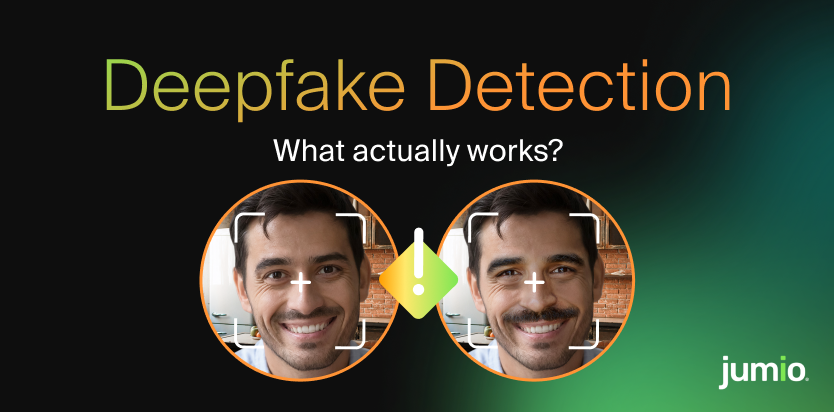
Deepfake detection has moved from an academic curiosity to a core operational requirement for any organization running identity verification at scale. The AI-generated synthetic media threatening Know Your Customer (KYC) pipelines, onboarding workflows, and biometric authentication systems bears little resemblance to the crude face-swaps of five years ago. Deepfake files continue to surge, along with fraud attempts tied to synthetic media.
The financial exposure is stark. In 2024, an employee was tricked into sending $25 million to fraudsters, after a deepfake video call with their CFO. Legacy verification methods designed for static photo attacks simply weren’t built for this threat model.
What follows is a technical examination of deepfake mechanics, detection myths, real-world attack vectors, and the enterprise-grade prevention strategies that actually hold up in 2026.
What Are Deepfakes?
Deepfakes are synthetic media created through deep learning neural networks that manipulate or generate realistic audio, video, and images. The term is a portmanteau of “deep learning” and “fake,” and the concept traces back to 2014, when Ian Goodfellow published his seminal paper on generative adversarial networks (GANs) at the University of Montreal. GANs work through iterative refinement: two competing networks — one generating content, one attempting to detect it — improve each other until the output becomes photorealistic.
How Are Deepfakes Made?
Modern deepfake pipelines follow a predictable workflow: data collection, model training, and generation and refinement.
The data collection phase involves gathering 500 to 5,000 images or video frames of the target individual from social media, public sources, or data breaches. Audio samples as short as three to 10 seconds are sufficient for voice cloning with current models. That training data feeds into neural network architectures — autoencoders and GANs — which learn facial geometry, texture patterns, and micro-expressions. Transfer learning using pre-trained models has compressed what once took days into hours.
Generation and refinement applies the trained model to a source video, overlaying the target face. Post-processing then removes artifacts and adjusts lighting.
The concern for identity verification is that “deepfake-as-a-service” platforms on dark web marketplaces now produce custom synthetic identities on demand, and mobile applications can execute real-time face-swapping during video calls without any local training. The technical barrier that once protected verification systems is gone.
Are Deepfakes Illegal?
The short answer is that it depends on jurisdiction and use case. Even where explicit laws are in place, enforcement significantly lags the technology.
In the U.S., there’s no comprehensive federal deepfake legislation as of 2026. The TAKE IT DOWN Act (S. 146) established federal criminal prohibition against non-consensual publication of intimate imagery, and the DEEPFAKES Accountability Act has been proposed but not enacted.
At the state level, California, Texas, and Virginia have criminalized specific deepfake uses, while existing fraud statutes and identity theft laws may apply depending on how the synthetic media is deployed.
Attribution complexity, cross-border operations, and First Amendment considerations all complicate prosecution. While platform immunity under Section 230 (U.S.) shields hosts from liability, bipartisan legislation has been introduced to create a deepfake exclusion.
Internationally, the picture is more prescriptive. The EU AI Act mandates that AI-generated content be labeled as artificial. The U.K. Online Safety Act 2023 criminalizes deepfake intimate imagery. China requires deepfake watermarking and disclosure, and Australia has amended its criminal code to address deepfake fraud specifically.
For compliance teams, the practical takeaway is that regulatory pressure is moving toward affirmative obligations to deploy technical controls — not waiting for incident reports.
Are Deepfakes Dangerous?
Deepfakes pose multifaceted threats spanning individual privacy, financial security, and institutional trust. Common attack categories include bypassing biometric authentication in banking and government services, synthetic identity fraud that combines real credentials with AI-generated faces, account takeover via deepfaked video verification, and fraudulent account opening at financial institutions.
The financial exposure of deepfakes is material and growing. Deepfake fraud losses are projected to reach $40 billion by 2027, up from just $12.3 billion in 2023. A 2019 CEO voice fraud case — where a deepfaked executive authorized a wire transfer — caused $243,000 in losses from a single attack.
Beyond direct financial loss, reputational damage from executive impersonation and fake product endorsements represents a secondary exposure that’s harder to quantify and even harder to reverse.
The business risk is compounded by broader societal destabilization that erodes the institutional trust organizations depend on. Fabricated candidate statements and election misinformation spread rapidly via social media. Manipulated media undermines confidence in authentic documentation. And harassment campaigns built on non-consensual intimate imagery cause documented psychological harm to targeted individuals.
When the public loses its baseline assumption that video evidence is real, the downstream effects on fraud adjudication, insurance claims, and legal proceedings are significant for any enterprise operating in regulated industries. As courts and regulators grapple with synthetic media authentication, organizations that relied on video records for dispute resolution face a narrowing evidentiary foundation.
At the level of national security, military and intelligence impersonation, diplomatic incident escalation through fabricated communications, and critical infrastructure targeting via deepfake-enabled social engineering are all documented threat vectors at the state and enterprise level.
Deepfake Scam Types
Understanding attack taxonomy is prerequisite to defense architecture. Deepfake scams broadly fall across three categories:
1. Visual Deepfakes
The most familiar attack type is also the most directly threatening to document-based identity verification workflows. Variants include face-swapped video overlaying a target’s face onto an impostor, fully synthetic faces generated without any source individual, presentation attacks using pre-recorded deepfake video during liveness checks, and AI-generated ID documents with synthetic facial photos.
2. Audio Deepfakes
Most organizations place implicit trust in voice as an authentication signal — and attackers know it. Attack variants include voice cloning that replicates speech patterns, accent, and intonation, as well as real-time voice transformation during phone calls. CEO fraud — fabricated executive authorization for wire transfers — and customer service impersonation that bypasses voice authentication are the most operationally damaging variants.
3. Multimodal Deepfakes
When both signal channels are compromised simultaneously, the attack becomes significantly harder to catch. These attacks synchronize audio-visual manipulation for video calls with real-time face and voice transformation during live interactions, making them the most dangerous for any identity verification workflow requiring live video.
Delivery Mechanisms
How deepfake content reaches and defeats verification systems matters as much as the content itself. Unfortunately, the attack surface is wider than most teams anticipate.
Identity Verification Attacks
The most technically sophisticated attacks target the verification pipeline directly rather than the human reviewing it. Presentation attacks play pre-recorded deepfake video during a liveness check, while injection attacks feed synthetic video directly into the camera stream at the system level, bypassing the capture layer entirely.
Virtual camera hijacking uses malware to route deepfake footage to the verification application, and mobile emulators running real-time deepfake generation — combined with screen sharing deepfakes in video conferencing platforms — extend the attack surface beyond dedicated verification flows.
Social Engineering
Not all deepfake delivery relies on technical exploitation; a significant share depends on organizational process gaps. Deepfaked executive video calls requesting urgent wire transfers, and synthetic video bypassing call center security through customer impersonation, are the highest-volume variants.
Remote interview fraud — job applicants using deepfakes to impersonate qualified candidates — has emerged as a material risk for hiring pipelines, and family emergency scams using deepfaked loved ones to request financial help have moved from novelty to documented fraud pattern.
Account Takeover
Once an attacker can simulate a verified identity on demand, account recovery flows become a primary target. Deepfaked video verification is used to reset passwords and change account details, while synthetic selfies submitted through account recovery processes exploit the same biometric matching systems designed to protect users. Biometric authentication can be bypassed using stored photos converted into deepfake video, and multi-factor authentication falls to deepfaked video calls placed directly to support teams.
Synthetic Identity Fraud
Synthetic identity fraud pairs a real Social Security number (SSN) with an AI-generated facial image to construct a fictitious identity that passes standard onboarding checks. The same deepfaked face can be deployed across multiple fraudulent accounts simultaneously, and attackers routinely build credit history with synthetic identities over months before executing bust-out fraud.
Traditional detection models flag 85% to 95% of these identities as low-risk — a structural vulnerability that makes cross-transaction identity intelligence essential rather than optional.
Cryptocurrency and Financial Services
Digital asset platforms face concentrated deepfake exposure given the irreversibility of on-chain transactions. Exchange account opening with deepfaked KYC documentation, wallet recovery using fabricated video verification, and peer-to-peer transaction fraud with deepfaked buyer and seller verification are all established attack patterns. Loan application fraud using synthetic income verification videos extends the same playbook into traditional lending, where manual review processes create additional gaps for synthetic media to exploit.
How to Spot a Deepfake in 2026
The conventional wisdom around deepfake detection is operationally dangerous. Most circulating guidance applies to amateur deepfakes from before 2021, not the sophisticated AI-generated content that threatens production identity verification systems today.
Detection Myths That No Longer Work
Myth 1: “Look for unnatural blinking patterns.”
Modern GANs are trained on thousands of videos and replicate natural blink rates, duration, and eyelid movement. Blink detection has been incorporated into deepfake training pipelines since at least 2023, which means sophisticated deepfakes now show physiologically normal blinking indistinguishable from authentic video.
Myth 2: “Check for lighting inconsistencies.”
Advanced rendering engines model lighting, shadow direction, and ambient occlusion accurately. While neural rendering techniques match lighting between source and target, post-processing algorithms automatically correct shadow artifacts.
Myth 3: “Examine the hairline and face edges for blurring.”
High-resolution deepfakes maintain sharp boundaries at the hairline, jaw, and neck. Segmentation algorithms can precisely isolate facial regions, and any blended or blurred artifacts get largely eliminated through iterative refinement.
Myth 4: “Listen for robotic or unnatural voice patterns”
Voice synthesis models in 2026 replicate prosody, emotional inflection, and breathing patterns flawlessly, with as little as three seconds of sample audio being sufficient for a convincing voice clone. Real-time voice transformation maintains conversational naturalness and liveness, bypassing the need to generate recordings altogether.
Myth 5: “Check metadata and EXIF data.”
Reliance on metadata is obsolete, as it can be easily stripped or fabricated. Deepfake generation doesn’t leave distinctive metadata signatures, and real-time deepfakes have identical metadata to authentic video.
The 2026 Reality
Studies show humans perform at essentially chance level — 50 to 60% accuracy — when identifying modern deepfakes. Additional research confirms that visual inspection is unreliable regardless of training or expertise.
The fact is that manual detection is insufficient to catch deepfakes, scales poorly, and introduces liability exposure. Enterprise identity verification requires automated, advanced detection systems — not human review queues.
Deepfake Detection Tools That Actually Work
Effective deepfake detection requires a multi-layered technical approach combining advanced liveness detection, behavioral analytics, and cross-transaction intelligence. No single signal is sufficient.
Advanced Liveness Detection
Liveness detection — active, passive, and active illumination — is the foundational defense against deepfake presentation attacks, but there are meaningful performance differences across implementation types.
Active liveness detection requires users to perform randomized actions — head turns, facial expressions, following a moving object — that pre-recorded video cannot replicate. It detects screen replay, printed photos, and static masks and achieves ISO/IEC 30107-3 Level 1 certification. The key limitation is that it remains vulnerable to injection attacks and real-time deepfake generation, because the challenge is predictable.
Passive liveness detection analyzes a single image or short video without user action, examining texture patterns, micro-expressions, and physiological signals. It creates lower friction for legitimate users but has limited effectiveness against sophisticated video deepfakes.
Advanced active illumination is the current performance ceiling for commercial liveness systems. It projects randomized colored light sequences onto the face and analyzes reflection patterns, subsurface scattering, and specular highlights to detect 3D facial structure and material properties that distinguish real skin from screens and photos.
The randomized sequences are impossible for attackers to predict and pre-generate. ISO/IEC 30107-3 Level 2 conformance — the highest commercial standard — is achievable with this approach.
AI-Powered Anomaly Detection
Neural Network Forensics
GAN generation and face-swapping algorithms introduce artifacts that are invisible to human reviewers but detectable through frequency domain analysis. Temporal discontinuities across video frames, subtle inconsistencies in facial feature relationships, proportions, and movements all leave forensic signatures that trained neural networks surface reliably.
Critically, these models require continuous retraining on emerging deepfake techniques — any static model degrades as attack tooling evolves.
Behavioral Biometrics
Synthetic video has a characteristic movement signature that behavioral analysis can identify even when visual quality is convincing. Micro-expressions, eye movement patterns, and head pose dynamics are compared against population norms and historical user data, flagging deviations that indicate generated rather than organic motion.
Monitoring extends beyond the face itself to include typing patterns and mouse movements, with interaction patterns with the device itself providing additional signal that deepfake pipelines cannot replicate.
Multi-Modal Analysis
Correlating audio and visual signals for synchronization artifacts catches a class of attacks that either channel alone would miss. Lip sync accuracy, head movement matching speech patterns, and voice spectrogram analysis identifying synthetic speech generation all produce detectable mismatches when voice cloning and face-swapping are deployed together. An attacker who successfully generates convincing video still faces a compounding detection problem when audio-visual correlation is active.
Document-to-Selfie Verification
Comparing selfie biometrics to the government-issued ID photo adds a cross-reference layer that creates compounding difficulty for attackers. Facial recognition matching across documents and live video detects the same synthetic face deployed with different identity credentials — a reliable synthetic identity tell. Cross-referencing the Identity Graph flags duplicate faces with mismatched data, surfacing the signals that individual transaction analysis misses entirely.
Device Intelligence and Risk Signals
Virtual Camera Detection
Injection attacks depend on routing synthetic video through the camera input before the verification system ever sees it — and device intelligence is the primary defense. Suspicious camera drivers, modified system libraries, virtual camera software, mobile emulators, and screen mirroring are all identifiable at the operating system level before a frame of video is analyzed.
Monitoring for screen recording tools and video manipulation software running concurrently with a verification session adds a further detection layer that presentation-focused analysis alone cannot provide.
Environmental Analysis
The environment surrounding a verification attempt carries meaningful risk signals beyond the biometric itself. Screen glare patterns indicating video replay, audio artifacts like echo and unusual background noise, and inconsistent ambient lighting conditions all suggest the session is not what it appears.
There are several additional risk signals you can check during verification. For example, comparing geolocation data against IP address and device timezone provides an additional cross-reference that flags mismatches characteristic of emulated or remotely operated verification attempts.
Velocity and Pattern Analysis
Individual transaction analysis misses the coordinated attack patterns that become visible only at the network level. Unusual timing patterns, bulk verification attempts, and clusters of attempts sharing the same underlying infrastructure are signals that isolated session review cannot surface. Cross-transaction risk assessment connects these dots across accounts and time, identifying fraud rings operating at scale before individual losses compound into material exposure.
Jumio’s purpose-built liveness detection combines certified active illumination (ISO/IEC 30107-3 Level 2), AI-powered anomaly detection, and Identity Graph intelligence. Unlike white-labeled solutions, our in-house technology adapts in real-time to emerging deepfake techniques, processes verification decisions in seconds, and integrates seamlessly with identity document verification and biometric authentication workflows.
How to Prevent Deepfake Scams
Prevention at the organizational level requires a combination of technical controls, process design, and employee training. Let’s look more closely at deepfake prevention strategies for three types of deepfake scams: phishing, video, and messaging.
How to Protect Against Deepfake Phishing Scams
Email and Communication Security
Unexpected requests for wire transfers, password resets, or sensitive account changes should never be approved based solely on email or video call, regardless of how convincing the communication appears. Out-of-band verification — a phone call to a known number, or in-person confirmation for high-value transactions — is the minimum standard for anything with material financial or security consequences.
Code words and security questions established in advance for family and executive verification, combined with employee training on urgency tactics and authority appeals, close the process gaps that social engineering depends on.
Multi-Factor Authentication
Hardware security keys are structurally immune to deepfake attacks and represent the strongest available authentication factor. Time-based one-time passwords from authenticator apps and push notification approval to registered devices add layers that video manipulation cannot defeat.
SMS-based 2FA remains vulnerable to SIM-swapping and should not be treated as a primary factor. Instead, biometric authentication with certified liveness detection addresses the physical presence question that credential-based factors leave open entirely.
Organizational Protocols
Require dual authorization for all financial transactions above a defined threshold. This approach addresses the single-point-of-failure risk that executive impersonation attacks exploit. Implement callback procedures that verify caller identity independently before any sensitive information changes hands, and confirm video call participants through a separate channel before confidential discussion begins. Mandate physical signature requirements for high-risk document approval workflows that a synthetic video call cannot satisfy.
How to Prevent Deepfake Video Scams
Identity Verification Best Practices
ISO/IEC 30107-3 Level 2 certified liveness detection is the minimum deployment standard for any workflow handling material financial or regulatory risk.
Combining document verification, biometric matching, and liveness in a single workflow — with device intelligence screening for virtual cameras, emulators, and rooted devices — creates the layered redundancy that single-signal verification lacks. Random challenge-response requiring unpredictable actions, combined with multiple biometric samples captured at different time points, addresses the gap that deterministic active liveness leaves open.
Video Conferencing Security
Verify participant identity through an independent channel before any sensitive discussion begins, regardless of how familiar the video appears. Deploy randomized security questions using shared knowledge unknowable to a deepfake impostor, and ask participants to perform unexpected physical actions — a specific hand gesture, showing a physical object — that synthetic video pipelines cannot anticipate.
Monitor actively for suspicious video quality fluctuations and audio-visual synchronization issues, and record sessions for forensic analysis whenever fraud is suspected.
Platform-Specific Defenses
On platforms like Zoom, Teams, and Meet, enable waiting rooms requiring authentication before joining, disable virtual backgrounds during sensitive meetings, and use platform-native recording rather than third-party screen capture.
These configurations reduce the surface area available for virtual camera injection and unauthorized session access. Implement network-level monitoring to detect video injection attacks — application-level controls alone cannot catch threats operating at the system layer.
How to Stop Deepfake Scams in Messaging Apps
Signal, WhatsApp, Telegram
Urgent requests received through messaging platforms should be verified through a voice call before giving a response. Be sure to call the number through independently verified contact information, not through the message itself.
Use verification protocols requiring a video call displaying a specific physical item — like today’s dated newspaper or a government ID — for anything involving financial authorization. Disappearing messages for sensitive communications and security number verification detecting account takeovers reduce the persistent exposure that standard messaging configurations create. A cooling-off period implemented through delayed message sending for financial requests removes the urgency pressure that social engineering attacks depend on.
Voice Call Security
Require callers requesting sensitive actions to provide information only the legitimate contact would know, and make callback verification standard procedure — hang up and call back on an independently confirmed number for any high-value request.
Establish code words with family members and employees in advance for emergency verification that a cloned voice cannot replicate. Voice authentication should function as one factor within a multi-factor workflow, not as a sole criterion, and flag poor audio quality as a potential indicator of synthetic voice artifacts rather than a reason to lower scrutiny.
Organizational Messaging Security
Deploy enterprise mobile device management to prevent unauthorized app installation, and implement data loss prevention monitoring for sensitive information sharing across platforms. Require multi-factor authentication for all messaging platform access, and establish clearly documented protocols for financial authorization requests — ad hoc communication habits are where social engineering finds its footing.
Train employees specifically on messaging-platform social engineering tactics, which differ meaningfully from email-based phishing patterns and require distinct recognition skills.
Consumer Protection
Never send money based solely on a video call or voice message, regardless of how recognizable the sender appears. Verify emergency requests through an independent communication channel using known contact information — not contact details provided within the urgent message itself. Enable login alerts, device authorization, and session management on all financial accounts, and monitor actively for unauthorized transactions so suspicious activity gets reported before losses compound.
Deepfake Detection FAQs
What is a deepfake?
Deepfakes are AI-generated synthetic media using generative adversarial networks trained on thousands of real images to produce photorealistic video, audio, or images. In identity verification contexts, fraudsters deploy deepfakes to present AI-generated video that appears to show a legitimate account holder passing a liveness or biometric check.
Can AI deepfakes be detected?
Yes, but only with sophisticated, multi-layered detection — not manual review. Human visual inspection achieves only 50% to 60% accuracy on modern deepfakes. ISO/IEC 30107-3 Level 2 liveness detection with active illumination, AI-powered anomaly analysis, behavioral biometrics, device intelligence, and cross-transaction monitoring collectively provide effective defense.
What is liveness detection and how does it prevent deepfakes?
Liveness detection verifies that a biometric sample comes from a live, physically present person. Advanced implementations use active illumination with randomized color sequences, analyzing reflection patterns that reveal 3D facial structure and distinguish real skin from screens, photos, masks, and video. ISO/IEC 30107-3 Level 2 is the highest commercial standard and defeats deepfakes, injection attacks, video replay, and 3D mask attacks.
What is the difference between deepfake detection and liveness detection?
Deepfake detection analyzes media for GAN artifacts, frequency inconsistencies, and temporal anomalies to determine whether the content is AI-generated. Liveness detection verifies whether the biometric came from a live, physically present person. Each technique addresses distinct attack vectors, and comprehensive verification integrates both approaches in addition to behavioral analytics and device intelligence for multi-layered defense.
AI Companies Specializing in Deepfake Detection
As deepfake technology proliferates, point solutions addressing individual attack vectors are insufficient. While multiple vendors offer deepfake detection capabilities, comprehensive identity verification requires integrated solutions, not point products.
Effective deepfake defense requires purpose-built technology integrated throughout the identity verification lifecycle:
- Document verification detecting AI-generated fake IDs
- Facial recognition matching biometrics across documents and live capture
- Certified liveness detection preventing presentation and injection attacks
- Behavioral analytics flagging unnatural patterns
- Device intelligence identifying virtual cameras and emulators
- Cross-transaction monitoring detecting coordinated fraud
- Identity Graph intelligence revealing patterns invisible to isolated systems
Jumio pioneered the ID and selfie approach that became the industry standard. Now we’re leading the evolution to deepfake-resistant identity intelligence with technology no other provider can match.
Our proprietary liveness detection is purpose-built in-house — not white-labeled — combining active illumination with randomized color sequences, ISO/IEC 30107-3 Level 2 certification, and real-time adaptation to emerging attack vectors.
With a network spanning more than 500 million identities and over 5,000-plus ID types across more than 200 countries, Jumio is your solution to advanced identity verification.
The Bottom Line
Deepfake fraud is not a projected risk — it’s an active, daily threat costing businesses billions annually. The detection techniques that were adequate three years ago provide no reliable protection against current attack tooling. Organizations still relying on manual review queues, basic active liveness, or point-solution detection tools have a material exposure gap.
Closing that gap requires purpose-built, integrated platforms that combine advanced liveness detection, AI-powered fraud analysis, and cross-transaction intelligence in a single workflow. The organizations that move first on enterprise-grade deepfake defense will have a structural advantage in fraud loss rates, regulatory standing, and customer trust.
Protect your business from deepfake fraud with Jumio’s industry-leading identity verification platform. Our groundbreaking technology stops deepfakes, synthetic identities, and coordinated attacks that bypass legacy systems. Contact Jumio today to see how our deepfake-resistant identity verification solutions can strengthen your fraud prevention strategy while delivering seamless customer experiences.