The Identity Intelligence Framework: How Connected Data Creates Smarter Decisions

"The Identity Intelligence Framework" alongside circular portraits of people connected by a green digital network mesh.

The threat model that point-in-time identity verification was designed for no longer exists. Identity fraud losses reached $27.3 billion in 2025, growing consistently year over year since 2022, and the attack surface is expanding faster than static verification architectures can accommodate. Digital document forgeries surged 244% in 2024, now accounting for 57% of all document…

Agentic AI and Identity: What Happens When Identity Can Act on Your Behalf?

"Agentic AI and Identity: Understanding This Unique Security Challenge" featuring a white robot projecting digital options like 'Sign Up', 'Subscribe', and 'Transfer Funds'.

Autonomous AI agents don’t wait for instructions. They open accounts, initiate high-value transactions, modify access privileges, execute smart contracts, and interact with other AI agents — all without ongoing human confirmation. The implications for fraud are significant and already materializing. The FTC reported losses of $5.7 billion to fraud in 2024, and adverse outcomes from…

Age Verification Law Snapshot: US, Australia, UK, and EU in 2026

"Age Verification Law Snapshot" with a dotted world map and a digital ID card icon, featuring the Jumio logo.

Last Updated: August 2026 Age verification laws require online platforms to confirm a user’s age before granting access to restricted content or services. As of early 2026, these laws are actively enforced across the U.S., UK, EU, and Australia, with approximately half of U.S. states now mandating some form of age gating. The UK’s Online…

Deepfake Detection: What Actually Works for Identity Verification in 2026

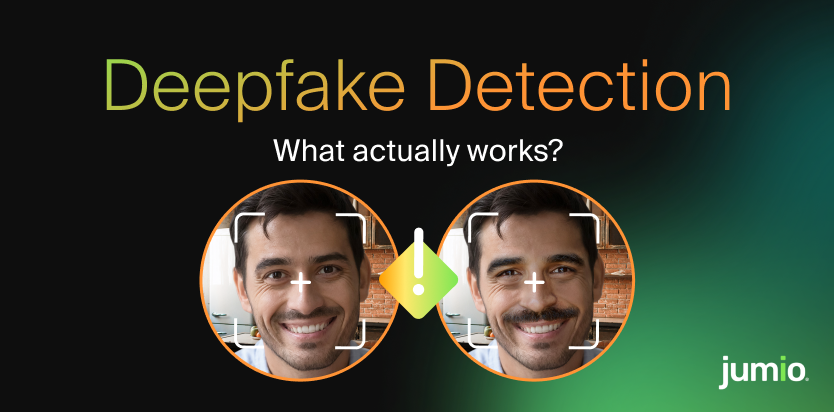
"Deepfake Detection: What actually works?" with the Jumio logo. Below the text, two side-by-side circular photos show the same man, one clean-shaven and one with a mustache, connected by an exclamation mark icon.

Deepfake detection has moved from an academic curiosity to a core operational requirement for any organization running identity verification at scale. The AI-generated synthetic media threatening Know Your Customer (KYC) pipelines, onboarding workflows, and biometric authentication systems bears little resemblance to the crude face-swaps of five years ago. Deepfake files continue to surge, along with…

How Decentralized Identity Changes Data Minimization Compliance

"Data Minimization Compliance: How Decentralized Identity Helps" featuring hands holding a smartphone emitting a glowing network node pattern over a laptop keyboard, with the Jumio logo in the corner.

In 2025, a major European bank was fined €4.4 million for collecting identity documents beyond what data minimization rules required. That fine was a clear signal: data minimization has moved from compliance aspiration to legal baseline, and regulators are actively enforcing it. Global privacy frameworks — the GDPR, CCPA, and a growing stack of U.S….

KYC vs AML: Complete Guide to Key Differences and Compliance Requirements

In today’s complex regulatory environment, financial institutions and digital platforms must balance user experience with stringent compliance standards. Two of the most critical acronyms in this space are Know Your Customer (KYC) and Anti-Money Laundering (AML). While often used interchangeably, these concepts represent distinct yet interconnected pillars of financial compliance. This guide breaks down the…

Why KYC is Important (and What it Actually Means)

In a world where financial crime and identity fraud are more sophisticated than ever, Know Your Customer (KYC) regulations have become the foundation of modern compliance programs. But for many, the term remains vague; something mentioned during account sign-ups or whispered during onboarding discussions. So, why is KYC important, really? KYC is a process used…

Building Fraud Rules, Faster: Introducing the Latest Enhancements to Jumio’s Rules Editor

building fraud rules faster

In fraud-detection systems, every workflow — from verifying a user’s identity to detecting suspicious activity — relies on rules. But as fraud patterns evolve, so does the complexity of rules. That’s why Jumio has enhanced its Rules Editor to make it easier and more powerful than ever to respond to emerging threats in real time….

Continuous Identity Intelligence: Why a One-Time Check No Longer Holds

Liminal Friday Five - Julie Roy, CMO, Jumio Blog Post

A customer you verify at signup does not stay the same customer for long. People move, switch jobs, change devices and phone numbers, and open and close accounts. The identity check that confirmed someone on day one slowly describes a person who no longer quite exists, and most verification systems never go back to ask…