A customer you verify at signup does not stay the same customer for long. People move, switch jobs, change devices and phone numbers, and open and close accounts. The identity check that confirmed someone on day one slowly describes a person who no longer quite exists, and most verification systems never go back to ask the question again.
Closing that gap is the work Jumio CMO Julie Roy cares about most. She recently joined Liminal’s Friday Five, the rapid-fire interview series hosted by Filip Verley, and across 5 questions, she kept returning to a single conviction: identity was never meant to be a one-time check, and treating it that way gets more expensive every quarter. Watch the full conversation on Liminal’s Friday Five.
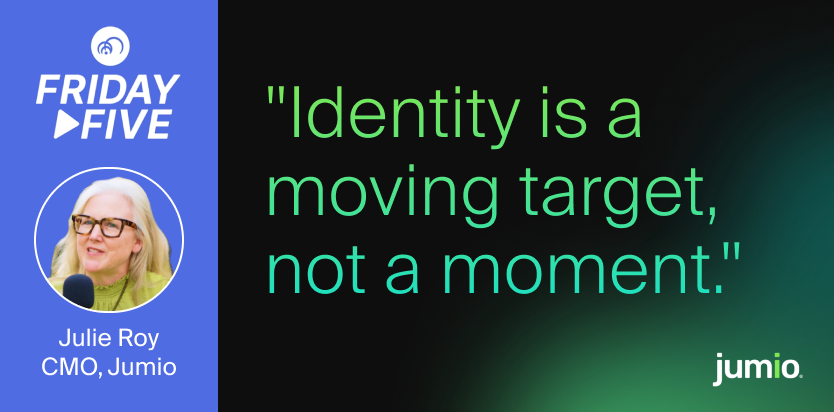
Identity is a moving target, not a moment
For years, the industry has treated verification as a gate. Confirm someone at onboarding, wave them through, and consider it closed. But people are constantly in motion. They move between organizations and accounts, pick up new devices and numbers, change addresses, and yes, some of them change the color of their hair. Each shift quietly erodes the confidence of that first check.
A clean signup is only a snapshot. Whether someone is still who they say they are, and still trustworthy, is a question that has to stay open. The answer is to continuously track identity, hold that trust across the full customer lifecycle, and treat verification as a continuous process that keeps monitoring risk long after the first check clears.
Continuous verification only holds if every check survives deepfakes
There is a catch that online businesses tend to underestimate, Roy said: deepfakes and AI-powered fraud. It is only going to get worse, she said. The tools for faking a face or injecting a video stream are cheap and continuously improving, and the fraudsters using them keep getting better.
This makes the lifecycle argument harder, not easier. Verifying someone continuously means nothing if any single check can be fooled by a synthetic face. Liveness detection, confirming that a real and present human is on the other side of the screen, stops being a feature and becomes the floor the whole system stands on. As Roy put it, providers do not get to be a step behind the people they are defending against. It is the thinking behind Jumio’s investment in premium liveness detection.
No single company sees enough on its own
The fair objection to continuous verification is that no one company sees enough of a person’s behavior to analyze them well over time. Roy’s answer is that the signal does not have to live inside one company’s walls.
That is the idea behind cross-transaction risk: capturing information while someone is active in one organization and, with the right controls, making it useful when they move to another. Jumio operationalizes this through its Cross-Transaction Risk capability and the Jumio Identity Graph, which connects past legitimate and fraudulent activity into a fuller view of each user. Framed this way, identity is something a network reads together, not a verdict any one company reaches alone. Someone flagged at one institution does not get a clean slate at the next.
Continuous verification should ask less of good customers, not more
Roy closed the Friday Five with the small hill she will die on: punctuality. It sounds trivial next to deepfakes and lifecycle risk, but it comes from the same place. Being on time is respect for other people’s time, and that instinct should shape how providers treat customers too. Every unnecessary check costs a customer’s time, as if it were free.
Done right, continuous verification flips that equation. It gives businesses more certainty while asking less of legitimate users, because the system already knows them and keeps watching for the signals that actually matter. That is the principle behind continuous identity intelligence like Jumio Watch: trust that is established once and then maintained, quietly, for as long as the relationship lasts.
Watch Julie Roy’s full Friday Five conversation with Liminal.