In today’s complex regulatory environment, financial institutions and digital platforms must balance user experience with stringent compliance standards. Two of the most critical acronyms in this space are Know Your Customer (KYC) and Anti-Money Laundering (AML). While often used interchangeably, these concepts represent distinct yet interconnected pillars of financial compliance.
This guide breaks down the differences between KYC and AML, explains how they fit into global regulatory frameworks, and provides a detailed overview of how businesses can stay compliant and build trust with customers.
KYC and AML Fundamentals: What Every Business Needs to Know
What is KYC (Know Your Customer)
KYC, or Know Your Customer, refers to the process businesses use to verify the identity of their customers. As a subset of AML, KYC ensures that companies are onboarding legitimate users and not inadvertently enabling criminal activity. It involves collecting, identifying information, verifying documents, and conducting background screening.
KYC processes are essential in industries like banking, fintech, cryptocurrency exchanges, investment platforms, and online marketplaces, all of which are high-value targets for fraud and financial crime.
By identifying and verifying a customer’s identity early in the relationship, businesses can assess risk levels and comply with legal requirements designed to stop money laundering, terrorist financing, and other illicit activities.
What is AML (Anti-Money Laundering)?
Anti-Money Laundering (AML) encompasses the broader set of laws, regulations, and internal policies used to prevent the movement of illicit funds through the financial system. The ultimate goal is to detect and deter crimes such as drug trafficking, terrorism financing, human trafficking, corruption, and organized fraud.
AML programs are guided by both international organizations and national regulators. Key frameworks include:
- Financial Action Task Force (FATF): Sets global AML standards.
- FinCEN (Financial Crimes Enforcement Network): U.S. regulatory authority.
- EU Anti-Money Laundering Directives (AMLD): Oversees compliance in the European Union.
AML requirements apply across industries and jurisdictions, and failure to comply can result in substantial penalties, reputational damage, and even criminal liability.
How KYC and AML Relate to Each Other
While KYC and AML are often mentioned together, KYC is just one part of a much larger AML strategy. Think of KYC as the front door; it’s your first line of defense. AML encompasses the entire building, from monitoring and audits to reporting and risk management.
Key Differences Between KYC and AML
Understanding the core differences between KYC and AML is essential for building a strong compliance program.
- AML refers to an end-to-end framework used to detect and prevent money laundering and financial crimes. It includes KYC, risk assessments, transaction monitoring, suspicious activity reporting (SAR), employee training, and regulatory compliance.
- KYC is a foundational piece within the larger AML framework. It’s the initial and ongoing process of customer identity verification and is used during onboarding plus ongoing authentication and risk profiling.
| Element | AML | KYC |
|---|---|---|
| Purpose | Prevent laundering of illicit funds | Verify customer identity |
| Methods | KYC methods plus risk assessments, suspicious activity reports (SARs), transaction monitoring | ID verification, biometric checks, and PEP/sanctions screening |
| Required For | All financial entities | Part of AML process |
How KYC Works Within the AML Compliance Framework
Step-by-Step Breakdown of a Typical KYC Process
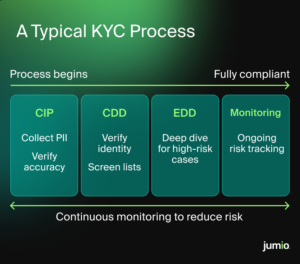
- Customer Identification Program (CIP).Businesses collect personally identifiable information (PII), such as full name, date of birth, address, and government-issued ID. Ensuring accuracy and data consistency is crucial.
- Customer Due Diligence (CDD). This step verifies the customer’s identity using documents, biometrics, or other technologies. It also involves screening against global watchlists, sanctions databases, and politically exposed person (PEP) lists.
- Enhanced Due Diligence (EDD) for High-Risk Customers. For customers deemed high-risk, businesses conduct deeper investigations into sources of funds and overall financial behavior. Additional document checks and approvals may be required.
- Ongoing Monitoring. Even after onboarding, customers must be monitored for changes in behavior, suspicious transactions, or evolving risk profiles. This ensures continued compliance and real-time risk management.
The Relationship Between CDD, EDD, and KYC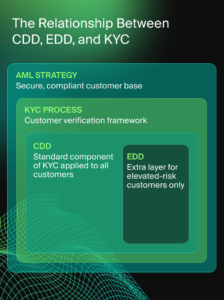
- CDD is a standard component of the KYC process.
- EDD is an additional layer applied to customers with elevated risk.
- Both serve the larger goal of maintaining a secure and compliant customer base within a broader AML strategy.
AML Program Components Beyond KYC
KYC lays the foundation for identifying legitimate customers, but AML programs require continuous monitoring and enforcement across the customer lifecycle.
Transaction Monitoring Systems
Effective AML compliance hinges on the ability to track and analyze customer activity in real time. Transaction monitoring tools flag suspicious behavior patterns, such as unusual transfers or high-volume activity, and generate alerts for investigation. These systems also support recordkeeping and regulatory reporting.
Suspicious Activity Reporting (SAR)
When potentially illicit activity is detected, institutions are legally required to file SARs with relevant authorities. Timeliness, accuracy, and completeness of SARs are critical to avoiding penalties. Documentation must be detailed and structured to regulatory standards.
Training and Awareness Program
All employees should receive AML training tailored to their roles. Regular updates ensure teams are aware of emerging threats, new regulations, and red flags to watch for. Training also helps build a culture of compliance across the organization.
Independent Testing and Audit
Internal audits and third-party assessments play a critical role in evaluating the effectiveness of AML programs. Regular testing ensures procedures are followed, weaknesses are identified, and systems evolve in response to new risks and regulatory guidance.
What Makes an Effective AML Program?
A best-in-class AML program includes the following core elements:
- Comprehensive KYC practices from onboarding through account closure.
- Ongoing risk assessments to identify changes in customer behavior or exposure.
- Real-time transaction monitoring and alert management procedures
- Robust documentation and recordkeeping that’s ready for audits or investigations.
- Continuous training programs to educate employees and mitigate human error.
- Dedicated compliance officers with authority to investigate and act.
Legal Frameworks to Know
Several major laws influence AML and KYC programs worldwide:
- Bank Secrecy Act (BSA): U.S. regulation requiring SARs and recordkeeping.
- USA PATRIOT Act: Expanded U.S. AML powers post 9/11.
- EU AML Directives: Provide a harmonized approach to AML across Europe.
Regulations continue to evolve in response to crypto, virtual assets, global terrorism, and cybercrime. Businesses must stay agile to remain compliant.
Where Are KYC and AML Regulations Required?
Global Regulatory Landscape
AML and KYC obligations are not confined to any single country. Over 200 jurisdictions follow the guidance of the Financial Action Task Force (FATF), which sets international standards and performs evaluations. Countries that fail to meet FATF standards may be placed on grey or black lists, limiting their access to global financial systems.
Industry Applications Beyond Banking
While AML requirements were traditionally associated with financial institutions, they now extend to a wide range of digital-first businesses, including:
- Fintech platforms offering payments or loans.
- Cryptocurrency exchanges and wallet providers.
- Online marketplaces facilitating peer-to-peer payments.
- Insurance providers and investment firms.
- Gaming and gambling platforms with real-money transactions.
FAQs About Know Your Customer and Anti-Money Laundering
What are the consequences of non-compliance with AML and KYC regulations?
Consequences of non-compliance may include:
- Fines totaling millions or even billions of dollars.
- Regulatory sanctions and loss of licenses.
- Criminal prosecution for executives.
- Lasting reputational damage.
Are there differences in AML vs KYC regulations?
Yes, AML (Anti-Money Laundering) and KYC (Know Your Customer) are complementary but distinct regulatory frameworks. AML includes KYC in addition to monitoring, reporting, and policy development, while KYC is a foundational element that focuses specifically on verifying identity and screening customers during onboarding and reverification. Both work together under broader financial crime prevention regulations.
Who is responsible for AML and KYC compliance?
- Internally: Compliance officers, legal teams, onboarding staff, and executives. The Chief Compliance Officer (CCO) or AML/BSA Officer usually leads the program, while front-line staff handle customer onboarding and initial screening. Compliance teams manage ongoing monitoring, risk assessments, and regulatory reporting, and senior management and the board provide oversight and ensure adequate resources.
- Externally: Regulators such as FinCEN (U.S.), FCA (U.K.), MAS (Singapore), and FATF (global) enforce compliance through examinations and penalties.
The Role of Technology in KYC and AML
Why Automation is Critical
Manual verification processes are prone to errors and delays, making it difficult to scale compliance effectively. With more sophisticated fraud threats and higher transaction volumes, automation is essential to maintain both accuracy and efficiency.
Modern Tools That Power Compliance
Technological innovations now enable smarter, faster compliance:
- AI-powered identity verification.
- Biometric facial recognition and liveness detection
- Machine learning models or detecting transaction anomolies.
- API-based integrations for seamless KYC/AML workflows.
Using advanced anti-money laundering technology, businesses can reduce friction, enhance fraud detection, and maintain compliance across global jurisdictions.
Let Jumio Help You Streamline AML and KYC
Navigating the complexities of AML technology, and KYC requirements doesn’t have to be overwhelming. Jumio’s industry-leading solutions combine document verification, biometric checks, and real-time screening to help you meet compliance standards with ease while improving customer experience.
Whether you’re a global bank, a crypto exchange, or an emerging fintech platform, Jumio provides scaleable AML tech to keep your business secure, efficient, and audit-ready.
Ready to simplify your compliance program? Learn how Jumio’s automated identity verification and AML screening solutions can simplify compliance and improve customer experience.
Originally published Sept. 9, 2021/ Updated Nov. 7, 2023