Identity Verification Software to Confirm Your Customers
Request a Demo

What is identity verification?
Identity verification is the process of confirming a person is who they claim to be before you give them access to an account, product, or service. Done online, it matches a real person to trusted evidence, typically a government-issued ID and a live selfie, replacing the need for an in-person ID check.
Identity verification combines document, biometric, and risk signals into a single decision rather than relying on one check. That layered assurance is what makes fraud prevention, KYC and AML compliance, and safe digital onboarding possible.
The term is often confused with two narrower, related checks. ID verification confirms only that a government-issued identity document is authentic, while document verification covers supporting documents like proof of address or bank statements. Identity verification combines these and more into a single decision about the person.
Identity Verification Services
Jumio's identity verification suite brings together the checks that confirm a real person is who they claim to be:


How identity verification works
Try Our Demo App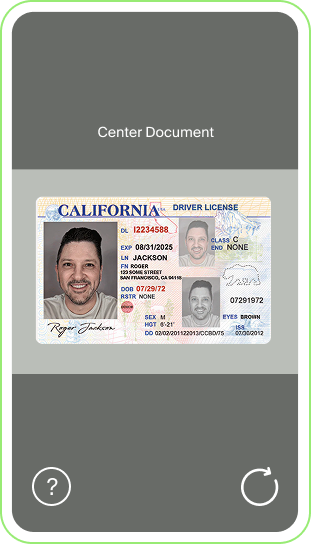


How identity verification works
Verify the ID’s authenticity
The customer photographs their government-issued ID. Jumio confirms the document is authentic and unaltered. (Learn more on our ID Verification page.)
Verify the person is present and living
The customer takes a selfie. A liveness check confirms they're physically present and a real person, then matches their face to the photo on the ID.
Make a risk-based decision
Jumio quickly assesses identity risk so businesses can make decisions based on their own risk tolerance, so genuine customers get through and fraud gets stopped.
Methods of identity verification
There are three main methods of identity verification. Strong solutions combine them rather than relying on just one, which is how Jumio reaches a confident decision while keeping onboarding fast.

Document verification
Confirms a government-issued ID, such as a driver’s license or passport, is authentic and unaltered. See ID Verification and Doc Proof.

Biometric identity verification
Matches a live selfie to the photo on the ID, with a liveness check confirming a real, present person rather than a photo or deepfake. See Selfie Verification and Liveness Detection.

Database and data checks
Cross-references the person’s details against authoritative and watchlist sources to confirm the identity exists and flag risk.
Identity verification for KYC and AML compliance
For regulated businesses, identity verification is the first step toward compliance. Know Your Customer (KYC) rules require you to confirm who your customers are at onboarding, and Anti-Money Laundering (AML) rules require you to screen them and monitor for risk. Identity verification provides the proof that a customer is real and genuinely present, which is the foundation both depend on.
Jumio helps you meet these obligations under frameworks like KYC, AML, and GDPR, and adapts as requirements change across regions. By automating verification, you satisfy regulators while keeping onboarding fast for legitimate customers.
Ready to see how Jumio can help you build digital trust?
Solution Highlights

Global Coverage
Liveness Detection
User Experience
Course Correction
Compliance
Security


Assurance at every step of the journey.

FAQs
- Driver’s License
- Passport or Passport Card
- State ID Card
- Permanent Resident Card